Bifidobacterium infantis: Benefits, Uses, Dosage & Food Sources

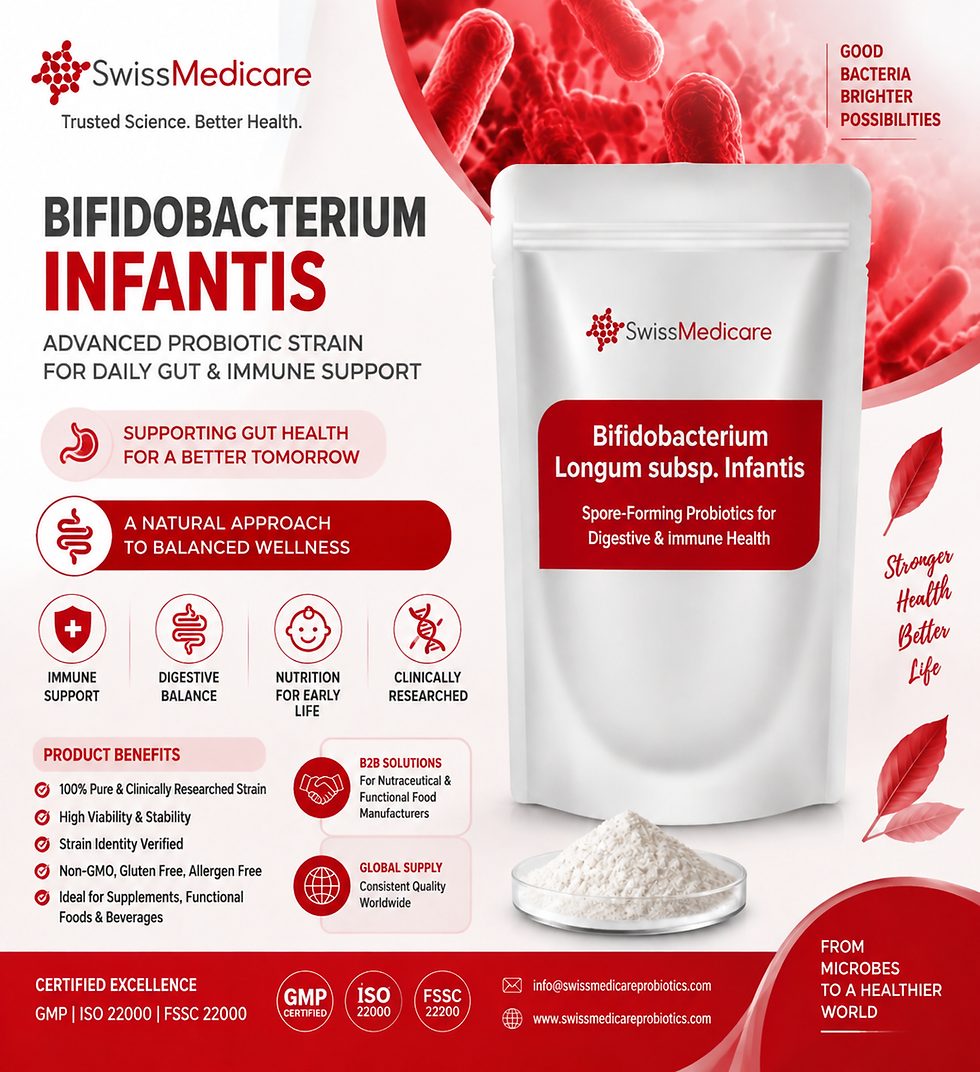
Bifidobacterium infantis is a well-studied beneficial bacterium associated particularly with the developing infant gut microbiome. It is best known for its ability to utilize human milk oligosaccharides (HMOs)—complex carbohydrates naturally present in human breast milk that are not digested by the infant but can selectively nourish certain beneficial bacteria.
Modern research has also explored Bifidobacterium infantis in probiotics designed for adults, digestive health, immune support, and microbiome-focused formulations.
This guide explains what Bifidobacterium infantis does, its potential benefits, uses in probiotic formulations, dosage considerations, natural sources, and how brands can select a high-quality ingredient.
What Is Bifidobacterium infantis?
Bifidobacterium infantis is a Gram-positive, anaerobic bacterium belonging to the genus Bifidobacterium. It naturally occurs in the gastrointestinal tract, particularly during early infancy. The organism has attracted considerable scientific interest because of its specialized ability to utilize carbohydrates found in human milk.
The current scientific name is Bifidobacterium longum subsp. infantis. The former name Bifidobacterium infantis is still commonly encountered in probiotic products and research literature.
One of its most distinctive characteristics is its relationship with human milk oligosaccharides. Studies have shown that Bifidobacterium infantis can use a broad range of HMOs as nutritional substrates. Unlike many bacteria that cannot efficiently use these complex carbohydrates, Bifidobacterium infantis possesses specialized transport and metabolic systems that allow it to access them.
This relationship helps explain why Bifidobacterium species are commonly associated with the microbiota of breastfed infants. Human milk essentially provides not only nutrition for the infant but also specialized carbohydrates that can help shape the infant's microbial ecosystem.
The bacterium is also used as a probiotic ingredient, although the effects of probiotics are highly strain-specific. A benefit demonstrated for one strain should not automatically be assumed for every Bifidobacterium infantis strain.

Core Functions and Benefits of Bifidobacterium infantis
1. Supports Gut Microbiome Balance
Bifidobacterium infantis can contribute to a balanced intestinal microbial ecosystem by competing for available nutrients and interacting with other microorganisms.
During infancy, Bifidobacterium can become a prominent member of the gut microbiota. Its ability to consume HMOs gives Bifidobacterium infantis a particularly important ecological role in the breastfed infant gut. Research describes Bifidobacterium infantis as an important HMO-utilizing organism associated with early-life microbiome development.
Bifidobacterium infantis also participates in microbial cross-feeding. Its metabolic products can become substrates for other bacteria, helping create a more interconnected microbial community.
For this reason, Bifidobacterium infantis is often considered not simply an isolated probiotic organism but part of a broader microbial network.
2. Supports Digestive Health
Bifidobacterium species are frequently incorporated into digestive-health probiotic products because of their interaction with the intestinal environment.
Bifidobacterium infantis can ferment specific carbohydrates and produce metabolites such as acetate and lactate. These metabolites can influence the surrounding microbial ecosystem and intestinal environment.
In infants, clinical research has reported that supplementation with specific Bifidobacterium infantis strains can increase Bifidobacterium abundance and influence stool characteristics and microbial metabolites. For example, a randomized trial using Bifidobacterium infantis M-63 at 1 billion CFU per day in healthy term infants reported increased Bifidobacterium abundance, increased stool acetate and IgA, and good tolerability.
These findings are strain-specific and should not be interpreted as evidence that every Bifidobacterium infantis product produces the same effects.
3. May Support Immune Function
The gut microbiome and immune system are closely connected. Bifidobacteria interact with intestinal cells and immune pathways through microbial metabolites and other molecular signals.
Research involving Bifidobacterium infantis has investigated changes in inflammatory biomarkers and immune-related responses. In one clinical research program, administration of the strain was associated with changes in inflammatory biomarkers in certain study populations.
However, probiotic products should not be presented as treatments for inflammatory or immune diseases unless supported by appropriate clinical evidence and permitted regulatory claims.
A more scientifically appropriate description is that Bifidobacterium infantis may support normal microbiome–immune interactions.
4. Infant Gut Health
Bifidobacterium infantis has a particularly important relationship with early-life gut ecology.
Human milk contains numerous HMOs that resist digestion by human enzymes and reach the intestine. Some Bifidobacterium species have evolved specialized mechanisms for using these carbohydrates. Bifidobacterium infantis is especially efficient at utilizing a broad range of HMOs.
This creates a fascinating nutritional relationship:
Recent research continues to investigate how early Bifidobacterium infantis colonization may influence microbiome development and immune maturation.
5. Adult Gut Health
Although Bifidobacterium infantis is strongly associated with infancy, adults can also use probiotic formulations containing selected strains.
Importantly, the abundance of Bifidobacterium infantis naturally tends to change as the diet and gut environment change. The infant microbiome is strongly influenced by milk-based nutrition, while adult microbiomes contain different communities adapted to more diverse dietary substrates.
Therefore, an adult probiotic containing Bifidobacterium infantis should be viewed as a strain-specific supplementation strategy, rather than an attempt to recreate an infant microbiome.
Health Applications of Bifidobacterium infantis
Bifidobacterium infantis and IBS
Irritable bowel syndrome (IBS) is one of the most studied areas involving Bifidobacterium infantis probiotics.
A major clinical trial evaluated Bifidobacterium infantis in women with IBS. Participants received different doses, including 10⁶, 10⁸, and 10¹⁰ CFU formulations, allowing researchers to investigate dose-related effects.
The important lesson for consumers and product developers is that strain identity matters. Evidence for Bifidobacterium infantis cannot automatically be transferred to another Bifidobacterium infantis strain.
Some subsequent research has produced mixed results depending on the population and outcome measured. For example, a randomized study in people with abdominal discomfort and bloating found no significant difference in mean symptom severity between Bifidobacterium infantis and placebo, although the probiotic group had more bloating-free days.
Therefore, Bifidobacterium infantis can be considered a promising probiotic for digestive-health formulations, but it should not be marketed as a universal IBS treatment.
Gut Inflammation
Bifidobacterium infantis has also been investigated for its potential role in regulating inflammatory responses.
Research on Bifidobacterium infantis has reported changes in inflammatory biomarkers in certain clinical populations.
These findings are scientifically interesting because they support the concept that selected gut microorganisms can influence host immune signaling. Nevertheless, more research is required before making broad disease-related claims.
Supporting the Gut After Antibiotics
Antibiotics can alter the composition and diversity of the intestinal microbiome. Probiotic formulations containing Bifidobacterium species are therefore sometimes used during or after antibiotic exposure.
However, evidence for Bifidobacterium infantis specifically in antibiotic recovery is more limited than the broader evidence for multi-strain probiotics. Some clinical studies of antibiotic-associated diarrhea have used combinations containing Bifidobacterium infantis along with other probiotic organisms.
This distinction is important: evidence for a multi-strain formulation should not be interpreted as proof that Bifidobacterium infantis alone produces the same outcome.
Overall Digestive Wellness
For healthy consumers, Bifidobacterium infantis may be included in a broader digestive-wellness formulation alongside other Bifidobacterium and Lactobacillus strains, prebiotics, fibers, or other functional ingredients.
The objective is generally to provide a diverse combination of beneficial microorganisms rather than relying on a single species for every aspect of gut health.
How to Use Bifidobacterium infantis
Bifidobacterium infantis can be incorporated into several types of probiotic products, including:
Capsules
Tablets
Powder sachets
Stick packs
Functional foods
Powdered nutritional products
Synbiotic formulations
Multi-strain probiotic blends
For adults, the product should be used according to the manufacturer's recommended serving size and storage instructions.
For infant products, formulation requires additional care. Age, strain, viable count, delivery format, feeding pattern, regulatory requirements, and product stability all need to be considered.
Best Practices for Formulation
A high-quality formulation should consider:
1. Strain selection: Different Bifidobacterium infantis strains may have different functional characteristics.
2. Viability: The number of viable microorganisms should remain within the product specification throughout shelf life.
3. Stability: Moisture, oxygen, temperature, packaging, excipients, and processing conditions can affect probiotic survival.
4. Compatibility: Bifidobacterium infantis should be evaluated for compatibility with other probiotic strains and prebiotic ingredients.
5. Packaging: Moisture- and oxygen-protective packaging can be particularly important for sensitive probiotic organisms.
6. Quality testing: Identity, purity, potency, microbiological safety, and stability should be appropriately evaluated.
Recommended Dosage of Bifidobacterium infantis
There is no single universal Bifidobacterium infantis dosage suitable for every product, age group, strain, or health objective.
Clinical studies have used a wide range of doses. For example:
1 × 10⁹ CFU/day of Bifidobacterium infantis was evaluated in healthy term infants.
IBS research involving Bifidobacterium infantis evaluated doses ranging from 10⁶ to 10¹⁰ CFU in an encapsulated formulation.
Another clinical study investigated Bifidobacterium infantis at 10⁹ CFU/day for abdominal discomfort and bloating.
For adult dietary supplements, products containing approximately 10⁸–10¹⁰ CFU per daily serving can be found in research and commercial formulation contexts, but this should not be interpreted as a universally recommended therapeutic range.
The appropriate amount depends on:
Strain
Target population
Intended use
Dosage form
Product stability
Evidence supporting the specific strain
Regulatory requirements
Viability through shelf life
For infant, premature-infant, medically vulnerable, or immunocompromised populations, probiotic use should be guided by an appropriate healthcare professional.
Natural Food Sources and Where to Find Bifidobacterium infantis
One of the most important points about Bifidobacterium infantis is that there is no reliable list of ordinary foods that naturally provides a standardized dose of this organism.
Bifidobacterium infantis is particularly associated with the infant gut, especially in breastfed infants. Human breast milk itself is better described as a source of HMOs that can nourish Bifidobacterium infantis rather than simply a food containing a predictable probiotic dose of Bifidobacterium infantis.
Research has demonstrated that Bifidobacterium infantis can use HMOs as a carbon source, helping explain its ecological association with the breastfed infant gut.
Fermented foods such as yogurt, kefir, fermented vegetables, and other cultured products may contain various microorganisms, but consumers should not assume that they contain Bifidobacterium infantis in meaningful or standardized quantities.
For a defined dose and specific strain, a quality-controlled probiotic supplement is generally a more predictable delivery method.
How to Choose a High-Quality Bifidobacterium infantis Supplement
Whether you are a consumer or a product developer, several factors are important when selecting a Bifidobacterium infantis probiotic.
1. Look for the Full Strain Identity
A label that simply states "Bifidobacterium infantis" provides less information than one identifying the complete strain designation.
Strain-level identification is particularly important because clinical evidence is often strain-specific.
2. Check the CFU Quantity
Look for the stated viable count per serving and determine whether the declared CFU applies:
At manufacture, or
Through the stated shelf life.
A product that guarantees potency through expiry provides more useful information than one that only lists the manufacturing count.
3. Check Storage Requirements
Bifidobacteria are living microorganisms and can be sensitive to moisture, oxygen, and temperature.
Choose products with clearly stated storage conditions and packaging appropriate for probiotic stability.
4. Evaluate Quality Testing
For B2B buyers, important documentation can include:
Certificate of Analysis (COA)
Strain identity documentation
Microbiological specifications
Potency testing
Contaminant testing
Stability data
Manufacturing specifications
Traceability documentation
5. Consider Formulation Compatibility
If Bifidobacterium infantis is being used in a multi-strain formula, the manufacturer should evaluate compatibility between the strains and all other ingredients.
Prebiotics can also be considered where scientifically and technically appropriate.
Swiss Medicare Probiotics: Bifidobacterium infantis for B2B Probiotic Formulation
For brands developing probiotic supplements, functional foods, or microbiome-focused products, sourcing the right probiotic ingredient is only the first step. Strain quality, potency, formulation compatibility, stability, documentation, and scalable manufacturing are equally important.
Swiss Medicare Probiotics positions itself as a B2B probiotic manufacturer and supplier supporting brands seeking premium probiotic ingredients, including Bifidobacterium infantis for customized formulations.
Its B2B approach can support product developers looking for:
Bifidobacterium infantis probiotic ingredients
Custom probiotic blends
Strain-specific formulations
Bulk probiotic manufacturing
Private-label and contract manufacturing support
Capsule and powder formats
Functional food applications
Dietary supplement formulations
Pharmaceutical and nutraceutical development
Technical and formulation support
For international brands, a strong probiotic manufacturing partner should be able to support the product development process from strain selection and formulation design through manufacturing, quality control, packaging, and scale-up.
Swiss Medicare Probiotics can therefore be positioned as a formulation partner for companies developing next-generation digestive-health and microbiome products based on Bifidobacterium infantis and complementary probiotic strains.
Final Takeaway
Bifidobacterium infantis is a distinctive member of the Bifidobacterium genus with a particularly strong connection to the infant gut microbiome. Its ability to utilize human milk oligosaccharides makes it especially interesting in early-life microbiome research, while selected strains have also been investigated for adult digestive and immune-related applications.
The scientific name Bifidobacterium longum subsp. infantis is now used taxonomically, although "Bifidobacterium infantis" remains a familiar name in probiotic products and research.
For product developers, the most important lesson is that probiotic benefits are strain-specific. A high-quality Bifidobacterium infantis product should therefore combine accurate strain identification, appropriate potency, validated manufacturing processes, stability testing, suitable packaging, and transparent quality documentation.
For brands seeking a B2B partner, Swiss Medicare Probiotics can be positioned as a trusted probiotic manufacturing and ingredient-supply partner for Bifidobacterium infantis and customized probiotic formulations. Its capabilities can support dietary supplement, functional food, nutraceutical, and pharmaceutical brands seeking scalable probiotic solutions, from custom formulation and bulk supply to finished-product manufacturing.
As microbiome science continues to develop, Bifidobacterium infantis remains an important organism for understanding how diet, microbial metabolism, gut ecology, and host biology interact—particularly during the critical early stages of life.
Disclaimer: This article is for educational purposes only and does not constitute medical advice. Probiotic effects can vary by strain, dose, formulation, and individual. Products intended for infants, premature infants, or medically vulnerable individuals should be developed and used with appropriate professional and regulatory guidance.
Frequently Asked Questions
What are the health benefits of Bifidobacterium infantis?
Bifidobacterium infantis may support a balanced gut microbiome, digestive health, and normal microbiome–immune interactions. It is particularly well known for utilizing human milk oligosaccharides and supporting the developing infant gut ecosystem. Benefits are strain-specific, so evidence for one strain should not automatically be applied to another.
What are the potential side effects of Bifidobacterium infantis?
Probiotics are generally well tolerated in healthy populations, but some people may experience temporary digestive symptoms such as gas, bloating, or changes in bowel habits after starting a probiotic.
Clinical studies of selected Bifidobacterium infantis strains have generally reported good tolerability.
People who are seriously ill, severely immunocompromised, have central venous catheters, or are otherwise medically vulnerable should discuss probiotic use with a healthcare professional because rare probiotic-associated infections have been reported.
How is Bifidobacterium infantis used in probiotics?
Bifidobacterium infantis can be used as a single-strain probiotic or combined with other Bifidobacterium, Lactobacillus, or other compatible microorganisms. It is available in formats such as capsules, powders, sachets, and functional food formulations.
The selected strain, dose, delivery system, and stability characteristics should match the intended application.
What is the recommended dosage of Bifidobacterium infantis?
There is no universal dosage. Research has evaluated different doses depending on the strain and target population. Examples include 1 billion CFU/day in an infant trial using Bifidobacterium infantis and doses ranging from 10⁶ to 10¹⁰ CFU in an IBS trial involving Bifidobacterium infantis .
For commercial products, dosage should be determined from strain-specific evidence, formulation stability, intended population, and applicable regulations.
What does Bifidobacterium infantis do?
Bifidobacterium infantis helps metabolize specific carbohydrates, particularly human milk oligosaccharides. Through fermentation, it produces metabolites that can influence the intestinal microbial environment and interact with other microorganisms.
Do adults need Bifidobacterium infantis?
Adults do not necessarily need Bifidobacterium infantis specifically. However, selected Bifidobacterium infantis strains may be included in adult probiotic products designed to support digestive and microbiome wellness. Whether supplementation is useful depends on the individual's needs and the evidence supporting the specific strain.
How do I get more Bifidobacterium infantis?
For infants, Bifidobacterium infantis is naturally associated with the early-life gut microbiome, particularly in breastfed infants. Human milk HMOs provide important substrates that can support its growth.
For adults, ordinary foods cannot be relied upon to provide a standardized quantity of Bifidobacterium infantis. A probiotic supplement containing a clearly identified Bifidobacterium infantis strain provides a more predictable amount.


Comments