What Is Bifidobacterium Probiotic Used For?

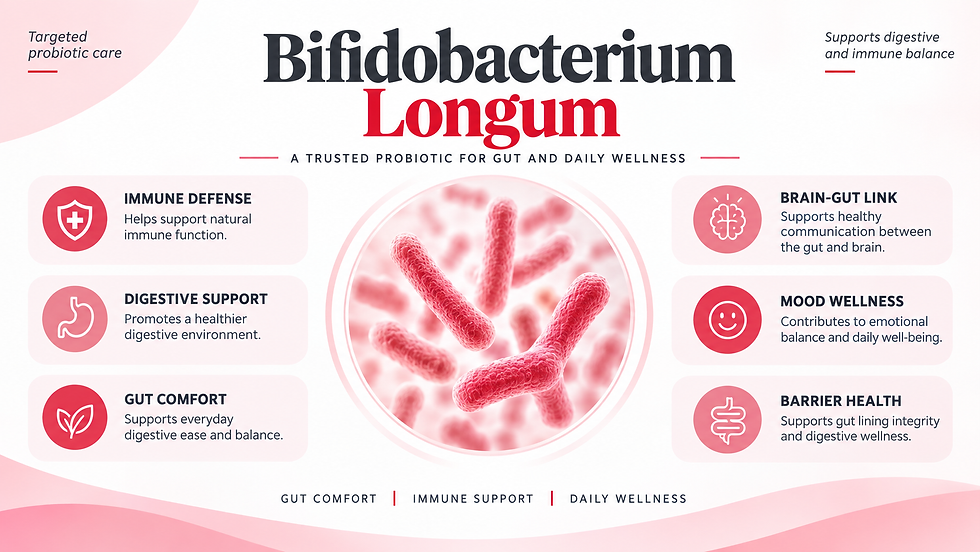
Bifidobacterium is one of the most widely studied probiotic genera and is naturally found in the human gastrointestinal tract. It includes species such as Bifidobacterium longum, Bifidobacterium breve, Bifidobacterium bifidum, Bifidobacterium infantis and Bifidobacterium animalis subsp. lactis.
Certain strains are used in probiotic supplements and functional foods because research has identified potential benefits for digestive health, microbiome balance and other aspects of human health.
What Is a Bifidobacterium Probiotic?
A Bifidobacterium probiotic contains selected live microorganisms belonging to the Bifidobacterium genus. Probiotics are defined as live microorganisms that, when administered in adequate amounts, confer a health benefit on the host.
The effects depend on the particular species and, importantly, the specific strain, because different strains can have different biological properties and clinical evidence.
What Is Bifidobacterium Probiotic Used For?
1. Digestive and Gut Health
Bifidobacterium probiotics are commonly used to support gastrointestinal health. Certain strains have been investigated for their potential effects on digestive symptoms, bowel function and the composition or activity of the intestinal microbiota.
Bifidobacteria can metabolize carbohydrates and interact with other microorganisms in the gut, contributing to the intestinal microbial ecosystem.
2. Maintaining Gut Microbiome Balance
The gut contains a complex community of microorganisms that interacts with digestion, metabolism and immune function. Certain Bifidobacterium strains may help influence this microbial environment through nutrient utilization, microbial interactions and production of metabolites.
Research on Bifidobacterium longum, for example, describes its role as a core member of the human gut microbiome and examines mechanisms through which it may interact with the host and intestinal ecosystem.
3. Bowel Regularity and Constipation Support
Some Bifidobacterium strains have been studied for their potential role in bowel regularity and constipation-related symptoms. Clinical research has examined specific strains and formulations rather than assuming that all Bifidobacteria have identical effects.
For example, studies involving Bifidobacterium longum have investigated bowel movement regulation and changes in the gut microbiome and metabolome.
4. Supporting the Intestinal Environment
Some Bifidobacterium strains can survive gastrointestinal conditions and interact with the intestinal environment. Their metabolic activities may influence the availability of nutrients and production of microbial metabolites.
These characteristics are among the reasons Bifidobacteria are frequently incorporated into probiotic formulations, including single-strain products and combinations with other probiotic microorganisms or prebiotic ingredients.
5. Immune System Support
The gut microbiome and immune system have a close relationship. Bifidobacteria are being studied for their ability to interact with intestinal and immune processes.
Research suggests that specific Bifidobacterium strains may influence immune-related pathways and contribute to host–microbiome interactions. However, probiotic products should not be considered replacements for medical treatment of infections or diseases.
6. Gut–Brain Axis Research
The gut–brain axis describes communication between the digestive system and the nervous system. Researchers are investigating whether certain probiotic strains can influence this communication through microbial metabolites, immune pathways and other mechanisms.
A clinical study investigated the specific strain Bifidobacterium longum in people with irritable bowel syndrome and reported changes in depression scores and brain activity. Such findings are interesting, but they apply to the studied strain and do not establish that all Bifidobacterium probiotics have the same effects.
7. Functional Foods and Nutritional Products
Bifidobacterium strains are used not only in capsules and powders but also in fermented and functional foods. They may be incorporated into dairy products, beverages and other formulations designed to deliver beneficial microorganisms.
Product formulation is important because probiotics must remain sufficiently viable during manufacturing, storage and consumption. Technologies such as encapsulation can be used to help protect probiotic microorganisms from unfavorable conditions.
Why Does the Bifidobacterium Strain Matter?
When choosing a Bifidobacterium probiotic, the species name alone does not provide the complete picture. For example, Bifidobacterium longum and Bifidobacterium longum are different strains and have been studied for different applications.
Therefore, consumers and product developers should consider the strain designation, dosage, viability, formulation, storage conditions, safety assessment and strain-specific clinical evidence. Modern probiotic research increasingly emphasizes precision strain selection because different strains can have different genetic and functional characteristics.
How to Choose a Bifidobacterium Probiotic
A quality Bifidobacterium probiotic should ideally provide clear information about the microorganism and product. Look for:
Specific species and strain identification
Declared viable count or CFU
Recommended daily serving
Appropriate storage instructions
Manufacturing and quality standards
Stability through the stated shelf life
Human clinical evidence where available
It is also important to remember that a larger CFU number does not automatically mean a product will be more effective. Probiotic efficacy depends on multiple factors, including strain, dose, formulation and the individual consumer.
Conclusion
Bifidobacterium probiotics are widely used to support gut health, digestive function and intestinal microbiome balance. Depending on the specific strain, research has also explored their potential roles in bowel regularity, immune interactions and the gut–brain axis.
The most important consideration is strain specificity. A probiotic product should not be evaluated solely by its genus or species name. The particular strain, dose, viability, formulation, quality and available clinical evidence all contribute to understanding its potential benefits.
As microbiome science continues to advance, Bifidobacterium probiotics are becoming increasingly important in the development of targeted and evidence-based approaches to digestive and overall health.
Frequently Asked Questions
What is Bifidobacterium probiotic used for?
Bifidobacterium probiotics are primarily used for digestive and gut microbiome support. Specific strains have also been studied for bowel regularity, immune-related functions and gut–brain interactions.
Is Bifidobacterium good for gut health?
Certain Bifidobacterium strains may support a balanced intestinal microbiome and normal gastrointestinal function. Benefits depend on the specific strain and formulation.
Can Bifidobacterium probiotics help with constipation?
Some strains have been studied for constipation and bowel regularity, with results varying according to the strain, dose and individual.
What are the most common Bifidobacterium probiotic species?
Commonly used species include Bifidobacterium longum , Bifidobacterium Breve . Bifidobacterium Bifidum. Bifidobacterium Infantis , Bifidobacterium Animalis subsp. Lactis
Are all Bifidobacterium probiotics the same?
No. Different strains can have different biological properties and supporting clinical evidence. The strain designation is therefore important when evaluating a probiotic.
Can Bifidobacterium probiotics support immunity?
Research indicates that certain Bifidobacterium strains interact with immune and intestinal processes. However, probiotics should not replace appropriate medical care.


Comments