What Is a Bifidobacterium longum Probiotic?


Bifidobacterium longum is a well-studied beneficial bacterial species that naturally occurs in the human gastrointestinal tract. It belongs to the genus Bifidobacterium, a group of microorganisms widely used in probiotic supplements and functional foods.
A Bifidobacterium longum probiotic contains selected live strains of this species that are provided in adequate amounts for a specific health purpose. Research has investigated Bifidobacterium longum for its interactions with the gut microbiome, intestinal environment and immune system.
What Is Bifidobacterium longum?
Bifidobacterium longum is a Gram-positive, anaerobic bacterium and an important member of the human gut microbiome. It can be found in people across different stages of life, although its abundance can vary according to factors such as age, diet, health status and other characteristics of the intestinal environment.
The species has attracted significant scientific interest because of its ability to utilize different carbohydrates and adapt to conditions within the gastrointestinal tract. Researchers have identified mechanisms that may help Bifidobacterium longum survive and interact with the intestinal environment.
How Does Bifidobacterium longum Work?
A probiotic does not simply work by permanently replacing the bacteria already present in the gut. Depending on the strain and individual, ingested probiotic bacteria may pass through the digestive tract, interact temporarily with the existing microbiota, or persist for some period.
Bifidobacterium longum can ferment certain carbohydrates and produce microbial metabolites. It may also interact with other microorganisms and with the intestinal lining.
These activities can influence the local gut environment and contribute to interactions between the microbiome and the host. Importantly, probiotic activity is generally strain-specific, meaning that different Bifidobacterium longum strains can have different characteristics and evidence.
Potential Benefits of Bifidobacterium longum Probiotics
1. Digestive and Gut Health
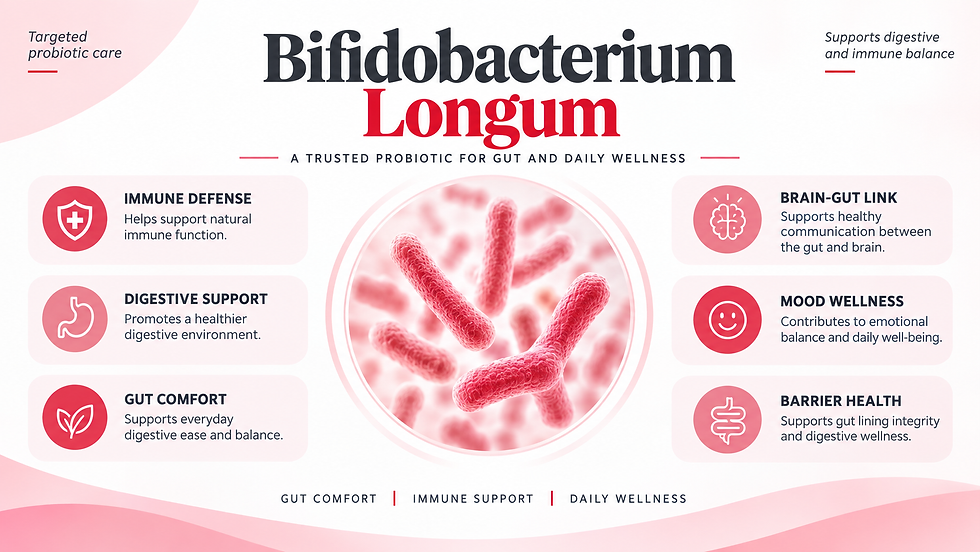
One of the main reasons Bifidobacterium longum is included in probiotic formulations is its potential role in supporting gastrointestinal health. Specific strains have been investigated in areas such as constipation, intestinal discomfort and other digestive conditions. However, the results of one strain should not automatically be applied to every Bifidobacterium longum product.
2. Supporting the Gut Microbiome
The gut microbiome is a complex ecosystem containing numerous species of bacteria and other microorganisms. Bifidobacterium longum is considered one of the core microbial species of the human gut. Research suggests that its abundance and activity are associated with the intestinal environment and host health.
Specific probiotic strains may influence the microbial community through competition, carbohydrate metabolism and production of microbial metabolites. These mechanisms are among the reasons Bifidobacterium longum continues to be investigated as a microbiome-supporting probiotic.
3. Immune-System Interaction
The gastrointestinal tract and immune system are closely connected. Certain Bifidobacterium strains have demonstrated interactions with immune pathways in laboratory and clinical research.
Research on the well-studied Bifidobacterium longum strain, for example, suggests that its effects may involve modulation of the gut microbiota and interactions between the microbiome and host. Such findings are promising, but they are specific to the strain and study conditions.
4. Gut-Brain Axis Research
Scientists are increasingly studying the gut-brain axis, the two-way communication network connecting the gastrointestinal system and nervous system. Certain Bifidobacterium longum strains have been investigated in relation to neurological and psychological outcomes.
This is an evolving field, and more research is needed to determine which strains, doses and formulations may have meaningful effects in humans. Therefore, claims about mood, stress or neurological benefits should always be linked to evidence for a particular strain rather than the species name alone.
Bifidobacterium longum vs. Other Bifidobacterium Species
Bifidobacterium longum is one species within the Bifidobacterium genus. Other commonly used species include Bifidobacterium bifidum, Bifidobacterium breve, Bifidobacterium animalis and Bifidobacterium longum subsp. infantis.
Although these microorganisms are related, they are not identical. Their genetic characteristics, carbohydrate-utilization abilities, survival properties and biological activities can differ. Therefore, selecting a probiotic based only on the genus or species may not provide enough information. The specific strain designation is an important part of evaluating probiotic evidence.
What Should You Look for in a Bifidobacterium longum Supplement?
When choosing a Bifidobacterium longum probiotic, consumers should consider strain identification, CFU count, product quality, stability and storage requirements.
CFU, or colony-forming units, indicates the quantity of viable microorganisms declared in the product. A larger CFU number does not necessarily mean a probiotic is more effective. The scientific evidence supporting the particular strain and its intended use is more important.
Because probiotic organisms can be sensitive to moisture, oxygen and temperature, appropriate manufacturing, packaging and storage are also important for maintaining viability throughout the product's shelf life.
Is Bifidobacterium longum Safe?
Probiotics are generally considered suitable for many healthy people when used according to product directions. Nevertheless, safety depends on the microorganism, strain, dose, formulation and user population.
People with serious medical conditions or significantly compromised immune systems should consult a healthcare professional before using probiotic supplements. Probiotics should not be considered a substitute for medically prescribed treatment.
Conclusion
Bifidobacterium longum is one of the important and extensively researched bacterial species used in probiotics. Its ability to interact with the gut environment, metabolize carbohydrates and participate in microbiome-host interactions makes it an important subject of modern probiotic research.
However, the most important point is that probiotic benefits are strain-specific. When evaluating a Bifidobacterium longum supplement, consumers and healthcare professionals should consider the exact strain, evidence, dosage, viability and product quality rather than relying only on the species name. Continued research will help clarify how different Bifidobacterium longum strains can be used to develop more targeted and evidence-based probiotic products.
Frequently Asked Questions
Is Bifidobacterium longum a probiotic?
Bifidobacterium longum is a probiotic bacterial species when specific strains are used in products that meet the accepted definition of a probiotic and provide a demonstrated health benefit. Not every strain automatically has the same probiotic effects.
What is Bifidobacterium longum used for?
It is commonly used in probiotic supplements and functional foods designed to support gut and digestive health. Specific strains have also been researched for immune, gastrointestinal and gut-brain-related applications.
Can Bifidobacterium longum be taken every day?
Many probiotic products are formulated for daily consumption. However, the appropriate amount and duration depend on the specific strain and product. Consumers should follow the manufacturer's recommended usage instructions.
Does Bifidobacterium longum permanently colonize the gut?
Not necessarily. Probiotic colonization varies among individuals and strains. Some strains may persist for a period, while others may primarily pass through the gastrointestinal tract. Diet, existing microbiota and the intestinal environment can influence colonization.
Is Bifidobacterium longum found naturally in the human gut?
Yes. Bifidobacterium longum is a naturally occurring member of the human gastrointestinal microbiome and has been detected across different stages of human life.


Comments